

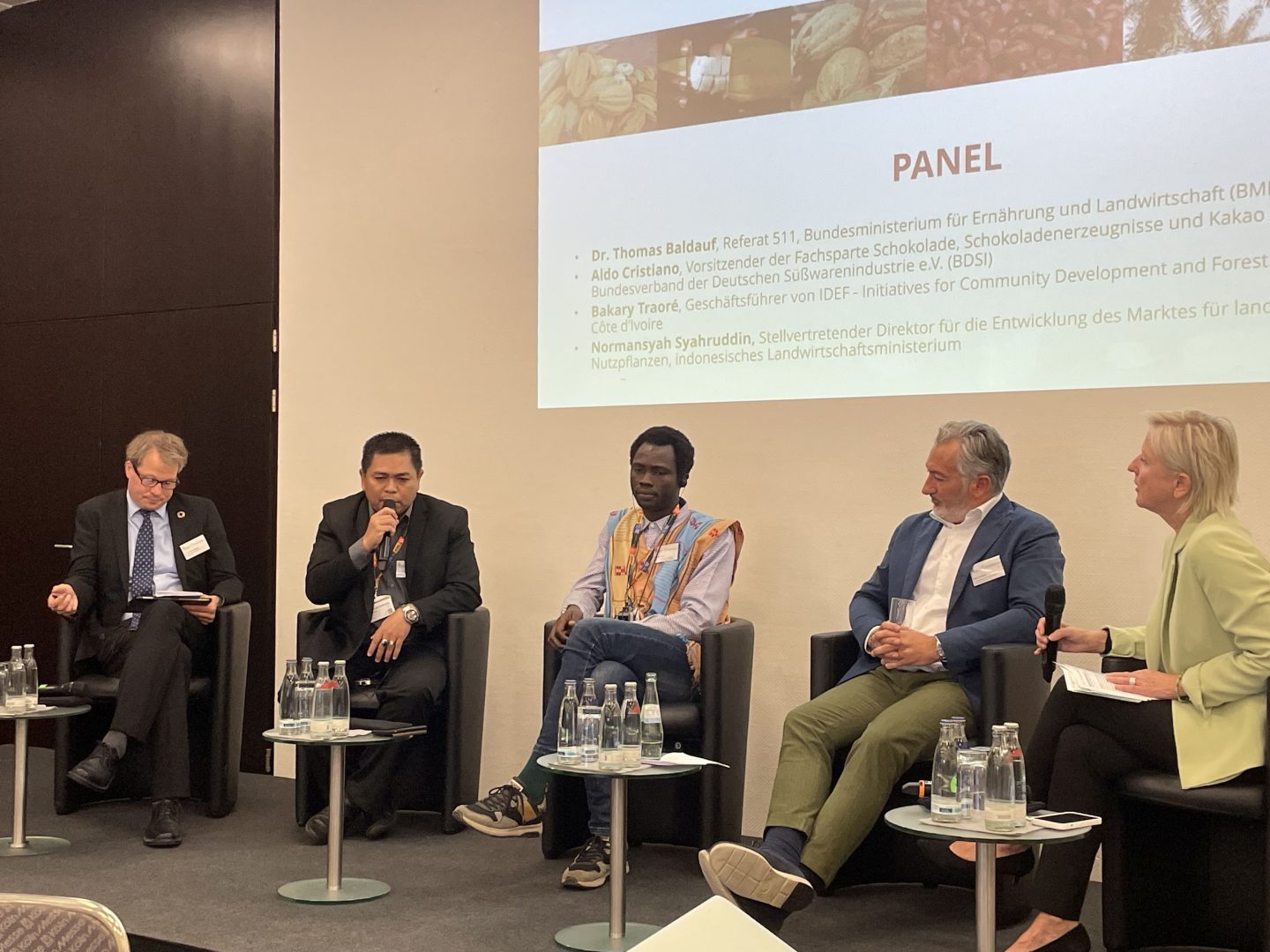
More than 70 participants from industry, politics and civil society discussed deforestation-free cocoa and palm oil production in Cologne on 9 October.
The focus was the EU Deforestation Regulation (EUDR): an important European Union initiative in the fight against deforestation and a genuine milestone for forest protection worldwide. With it, the EU also aims to make an important contribution against the climate crisis and species loss. The Forum for Sustainable Cocoa and the Forum for Sustainable Palm Oil organised a joint event at the Anuga trade fair for the first time. Actors from cocoa and palm oil supply chains shared their experience, discussed solutions and enabled cross-sector learning.
Through their work for sustainable supply chains, the Forum for Sustainable Cocoa and the Forum for Sustainable Palm Oil (FONAP) have many years of experience and considerable know-how that they intend to contribute to the current implementation of the regulation, up to the start of application on 30 December 2024, in Germany and at EU level.
Olaf Schäfer, Head of Sub-Directorate for Climate Action, Biodiversity, Sustainability and Bioeconomy at the Federal Ministry of Food and Agriculture (BMEL), welcomed the participants and set out the importance of the EUDR for agricultural supply chains. He emphasised how important exchange is in meeting the challenges and congratulated the Forum for Sustainable Cocoa and FONAP on the joint event.
Dr. Thomas Baldauf from the Federal Ministry of Food and Agriculture presented the regulation and the resulting obligations for operators and traders. Each year, forest equivalent to Germany’s entire forest area is destroyed from the world’s 4 billion hectares of forest. The regulation therefore aims to ensure that no deforestation takes place by enforcing corporate due diligence along the supply chain. He emphasised that, for the first time, an EU regulation includes a dedicated article on joint, strategic cooperation with third countries.
Challenges for smallholders
Particular attention must be paid to smallholders in the Global South when implementing the regulation. The speakers agreed on this. Evelyn Bahn, Deputy Chair of Forum Nachhaltiger Kakao e.V., emphasised: “Effective implementation of the regulation is possible only with complete traceability and transparency along the entire supply chain. It must be ensured that products come from deforestation-free sources. At the same time, cocoa farmers and palm oil producers on the ground must not be burdened still further. They should benefit from this regulation. Risks exist in particular for small-scale producers, for producers without land rights, or cooperatives that are still at an early stage.”
FONAP Chair Almut Feller likewise underlined this challenge: “There is a risk that smallholders will drop out of the supply chain in large numbers because they cannot meet the new EU requirements, or cannot meet them in time. As legislator, the EU has a major shared responsibility, in particular to support smallholders so that they remain part of the supply chain even under the strict EUDR rules. Our recommendation to the European Commission and the German government is to work together with operators and the other stakeholders in order to achieve optimal and timely implementation. FONAP will contribute to this within the scope of its possibilities.”
Learning from one another for sustainable solutions
The EUDR addresses the potential risk of small-scale producers being excluded from EU supply chains in Article 30 through partnership-based cooperation with third countries. Such an approach is unique in EU legislation to date and, for Germany, an essential element of the regulation, emphasised Dr. Thomas Baldauf from the BMEL, who also presented support offers to prepare for application of the EUDR.
That the risk of excluding small-scale producers can be managed is also shown by solutions from Indonesia and Côte d’Ivoire.
In Indonesia, work is under way on a national traceability system, reported Dr. Prayudi Syamsuri, Director for Processing and Marketing of Estate Crops Products, and Dr. Normansyah Syahruddin, Deputy Director for Estate Crops Market Development at the Indonesian Ministry of Agriculture. The national certification system Indonesian Palm Oil Standard (ISPO) is also intended to increase sustainability in oil palm cultivation. Smallholders in particular would need support.
Bakary Traoré, Managing Director of IDEF – Initiatives for Community Development and Forest Conservation, explained the challenges that must be addressed in Côte d’Ivoire in order to find effective solutions to prevent deforestation. Cocoa farmers must be supported and accompanied in order to maintain production on existing plantations, in particular to prevent them from switching to other products that are not produced for the European market. In this context, the functioning of the national traceability system currently being developed and piloted is of great importance. Many questions remain open here, said Traoré.
Aldo Cristiano, Chair of the Chocolate Division at the Association of the German Confectionery Industry, added that complete, comprehensive traceability is the basis for ending deforestation.
The importance of networking
In her closing remarks, Lisa Kirfel-Rühle, Deputy Head of Division at the Federal Ministry for Economic Cooperation and Development (BMZ), emphasised the importance of joint efforts to promote forest protection and sustainability in supply chains.
The BMZ offers a wide range of support to smallholders and companies. This includes two large-scale development programmes to continue securing smallholder access to the EU market. Companies can, among other things, use the advisory services of the Help Desk of the Agency for Business and Economic Development.
The discussions and insights gained during the event will help to advance implementation of the EU Deforestation Regulation and minimise possible negative effects on smallholder farms. They will also help to reinforce positive effects, for example greater transparency in the supply chain for all market participants.
Cover image: © Köhring PR Fotografie