

Member project Indonesia
Cooperation with FORTASBI in collaboration with the Indonesian NGOs Setara-Jambi and CAPPA, as well as Koltiva
At a glance
-
When
March 2022 to February 2023 (Phase 1) · September 2023 to September 2024 (Phase 2)
-
Who
Cooperation with FORTASBI in collaboration with the Indonesian NGOs Setara-Jambi and CAPPA
Involvement of Koltiva in Phase 2 -
Where
Tanjung Jabung Barat and Tebo (buffer zone to Bukit Tiga Puluh National Park), Jambi, Sumatra, Indonesia
Project partners
-
FORTASBI
In 2014, smallholder groups and local NGOs founded the Indonesian palm oil forum FORTASBI with the aim of promoting more environmentally and socially responsible oil palm cultivation among independent smallholders in Indonesia. Specifically, the forum supports small-scale producers in maintaining certifications, connects them with markets, and helps them increase productivity and improve their livelihoods.
-
CAPPA
The Yayasan CAPPA organization works to promote the more environmentally and socially responsible economic use of natural forest resources, based on multi-stakeholder processes and cooperation at various levels. CAPPA’s activities include dialogue initiatives, conflict resolution, strengthening networks, and supporting local communities and their economies.
-
SETARA Jambi
Yayasan SETARA was established in 2007 out of growing concern about the increasing expansion of conventional oil palm plantations in Jambi Province. The organization therefore worked to promote more environmentally and socially responsible palm oil in various regions of Sumatra by not only focusing on certification, but also supporting producers with training in good agricultural practices.
-
Koltiva
Koltiva is a leading technology company for building transparent supply chains. The company supports businesses and their suppliers with people-centered technology and practical solutions to adapt to changing regulations and meet consumer demand worldwide.
You are currently viewing a placeholder content from YouTube. To access the actual content, click the button below. Please note that doing so will share data with third-party providers.
More Information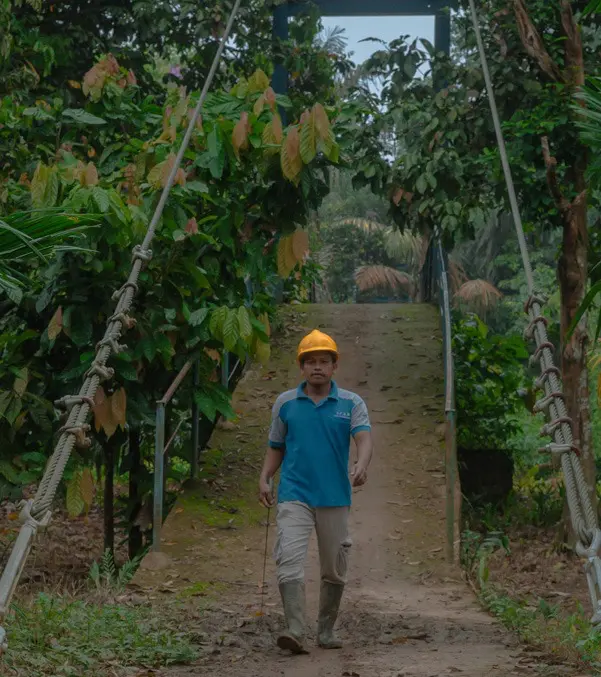
From sustainable palm oil to sustainable landscapes
"From sustainable palm oil to sustainable landscapes: the next step for production, conservation and greater participation"
In cooperation with the Indonesian palm oil forum for smallholders, FORTASBI, and the Indonesian NGOs Setara-Jambi and CAPPA, 27 FONAP members voluntarily took part in the pilot project in the world’s largest palm oil producing country.
The pilot project supported smallholders in operating more sustainably. From September 2023 to September 2024, it was in its second project phase and built on the previous year’s successes. In addition to Tanjung Jabung Barat, it also expanded into the neighboring district of Tebo. The project primarily pursued environmental objectives, but also social goals.
Cooperatives engaged in reforestation
The project region is located in the buffer zone to Bukit Tiga Puluh National Park. Forest fires caused devastation there in 2017 and 2018. Three cooperatives wanted to help restore an area of 17 hectares. To do so, they planted crops such as candlenut trees. Coffee can also thrive well in the shade of rainforest trees. The idea behind this is social forestry: not only the forest, but also the smallholders were meant to benefit.
In the first project phase, planting had already begun. In the second phase, the groups received support with professionalization. This was intended to ensure that the seedlings are well cared for and that group members can actually increase their income.
Women’s groups run nurseries
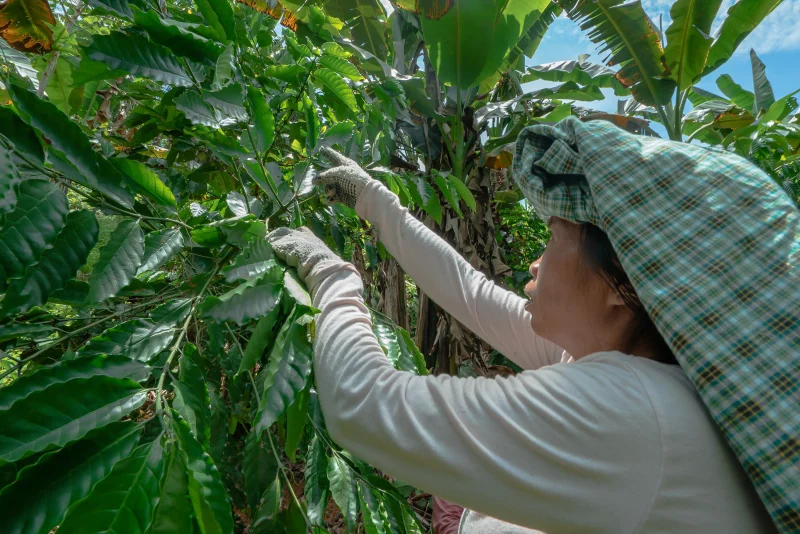
To restore the forest through social forestry, smallholders needed seedlings. In the first project phase, women’s groups with a total of 70 members set up three nurseries. Among other things, they sold young coffee plants and candlenut trees to the smallholder groups and at nearby markets.
The second phase was intended to enable them to generate a sustainable income from this. With support from the project, the women, for example, drew up business plans and registered officially. In addition, cooperation between the women’s groups and the smallholder groups was strengthened.
Villages engaged in river protection
The Pengabuan River flows through the project area. Along its banks, five villages began establishing protected zones and green buffer strips. Among other things, they aimed to reduce in the long term the share of oil palms that extend right up to the riverbank. As part of the traditional Lubuk Larangan concept, they also regulated fishing along a 4.5-kilometer stretch of the river. Ten villages also founded the River Watch Community KOMPAS, in which young people are particularly active.
In the second project phase, six additional villages were brought on board: three in Tanjung Jabung Barat and three in Tebo.
Oil palm small-scale producers used regenerative agriculture methods
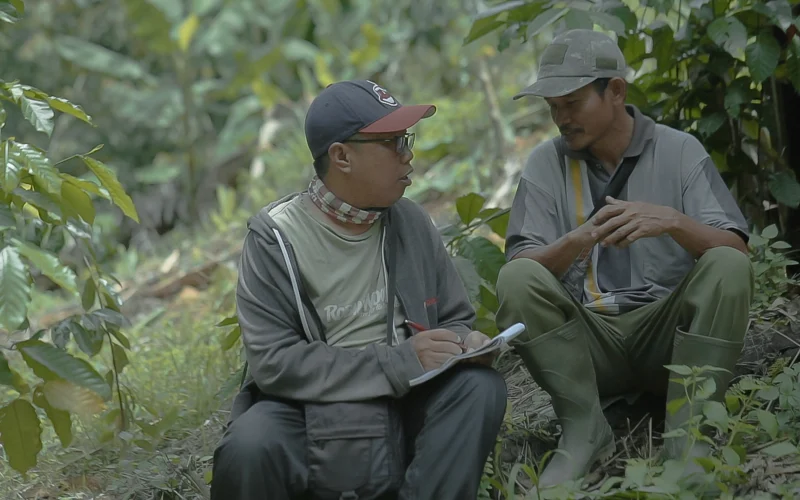
In the first phase, 536 RSPO-certified smallholders received training in regenerative agriculture practices, with a focus on soil fertility. There, for example, they learned how to replace conventional fertilizer with organic fertilizer. Instead of buying expensive chemicals, they can use materials that are often already available locally, such as goat urine or empty fruit bunches. This improves soil fertility and, in the long term, the growth of the palms and ultimately yields as well. On demonstration plantations, smallholders put the concepts into practice.
In the second project phase, the training continued: in addition to smallholders in Tanjung Jabung Barat, 200 producers in Tebo received training in more resilient cultivation methods.
Project partners recorded GPS data
Setara Jambi also collected information about growers in its project regions. However, the tools for analysis were lacking. To change this, in the second phase Koltiva came on board, a cooperation partner from the completed member project in Malaysia. Using the GDPR-compliant KoltiTrace system, the project recorded GPS data from smallholders. This not only helped with planning future interventions, but also simplified traceability of the palm oil produced. This is an important prerequisite for complying with the EU Deforestation Regulation (EUDR) and thus for market access in Europe.
You can find more videos from the project on our