


Certifications
Certification of palm oil
To promote more environmentally and socially responsible production of palm oil and palm kernel oil—and not least in response to global criticism of practices in palm oil cultivation—various certification systems have emerged in recent years. All of them pursued the goal of identifying challenges, engaging in dialogue with all relevant stakeholders, and developing approaches for resilient oil palm cultivation.
Certification systems are part of the solution for a more resilient palm oil sector. However, they cannot solve the sector’s problems on their own. This also requires support from national policy and European and/or international legislation (e.g., the EUDR/deforestation regulation and the LkSG/Supply Chain Due Diligence Act), enforcement of existing laws, and responsible producers and traders.
Over recent years, our forum has worked to improve certification systems. Despite all criticism, FONAP still considers certification systems an important tool.
Which certification systems does FONAP accept?
The Forum Sustainable Palm Oil currently accepts the following certification systems for implementing its voluntary commitment: RSPO and ISCC PLUS.
From 2025 onwards, organic certification in combination with RSPO Mass Balance or the Union for Ethical Biotrade (UEBT) will also be recognised. The changes will take effect from the 2026 monitoring round for the year 2025.
How is certified palm oil traded?
When sourcing certified palm oil, there are various trading options within supply chains. What all options have in common is that palm oil and palm kernel oil are produced on certified and audited plantations. However, the different trading models differ in whether certified palm oil is actually contained in the product or not. From 1 January 2027, only the trading models “IP = Identity Preserved” and “SG = Segregated” will be permitted, and the Mass Balance model only under strict requirements. For details on the Mass Balance model, see below.
You are currently viewing a placeholder content from YouTube. To access the actual content, click the button below. Please note that doing so will share data with third-party providers.
More InformationTrading models
Identity Preserved
The Identity Preserved (IP) trading option makes it possible to identify, all the way to the end product, which plantation the palm oil used comes from. Producing palm oil under the IP trading option requires complex and costly infrastructure. At the same time, it is a highly credible sourcing route, as the palm oil is 100% traceable back to the plantation.
Segregation
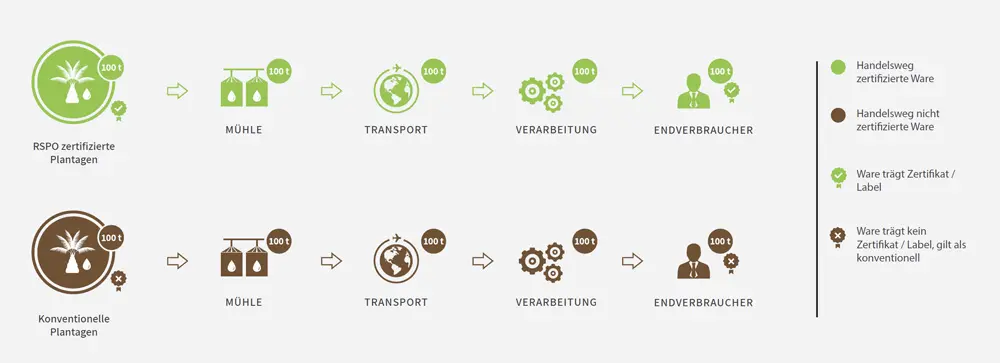
Similar to the Identity Preserved option, the Segregation (SG) trading option ensures that sustainably certified goods are consistently kept separate from non-certified goods throughout the entire supply chain. Producers and processors must ensure that the material flows demonstrably do not come into contact. Unlike IP, however, palm oil may be mixed from several certified plantations.
The product flow is verified by independent certification bodies. In this way, manufacturers of end products can ensure that the traded palm oil has been assessed for sustainability and monitored throughout the entire supply chain. Segregated palm oil is particularly relevant when using pure palm oil, as corresponding volumes are available on the market under this option.
Mass balance / Mass Balance
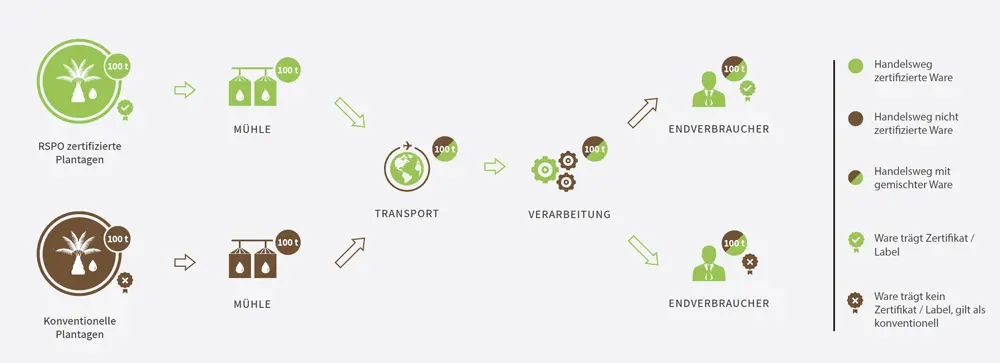
Under the mass balance model (MB), palm oil from certified plantations has so far been mixed with conventional, non-certified palm oil within the value chain. The share of certified goods was monitored, and it was ensured that no more of the end product was labelled as certified than had been introduced as certified before mixing. Certified palm oil is recorded and passed on through a bookkeeping system. The mass balance option thus made it possible to declare so-called “more sustainable” goods at every stage of the supply chain without having to build additional infrastructure for a parallel supply chain. Because certified and conventional goods were not physically separated, MB goods could be traded relatively easily within supply chains. However, this is NO longer possible!
Under the new legal requirements, only mixing of EUDR-compliant goods is permitted, i.e., deforestation-free palm oil from various legal and deforestation-free sources, provided that the geodata for all involved plots can be documented without gaps for the end product and stated in the due diligence statement.
This option is particularly relevant for the use of palm kernel oil and derivatives. However, with the entry into force of the European Deforestation Regulation, companies in the EU must ensure that no deforestation has occurred in the physical supply chains for palm (kernel) oil and its fractions.
Independent Smallholder certificates
A special feature is the so-called I.S. certificates (Independent Smallholder certificates) traded within the RSPO. This specific form of Book and Claim certificates is produced exclusively by independent smallholders. To date, it has been difficult to integrate independent smallholders into global certified commodity flows. The sale of I.S. certificates is therefore the only option for independent smallholders to produce palm oil sustainably and then sell it. FONAP therefore treats I.S. certificates as equivalent to all other trading options.
What does supply chain certification mean?
Certification of a supply chain under the RSPO Supply Chain Standard confirms continuous monitoring of all stages in the palm oil supply chain: from refining and processing through further processing and transport to distribution and arrival with the consumer.
All actors who come into lawful possession of RSPO-certified palm oil and physically handle the palm oil are required to carry out supply chain certification.
As a general rule, a company that wishes to be certified may only use the same trading model as its supplier or switch to a less stringent trading route. The raw material input with the lowest certification claim therefore determines the claim of the finished product.
In 2020, the RSPO Supply Chain Standard (RSPO SCC) was revised. A core element of the current standard is, among other things, regular verification by sites along the supply chain of the validity of suppliers’ supply chain certification or traders’ licences. In addition, RSPO members that source their goods directly from producers or mills must publish an up-to-date list of certified and non-certified supplying mills online.
More information is available here.
How can certified palm (kernel) oil be sourced?
Certifications in detail
RSPO
The “Roundtable on Sustainable Palm Oil” (RSPO) was founded in 2004 to counteract the negative environmental and social impacts of rapidly growing palm oil production. In just over twenty years, RSPO membership has grown from 5 to more than 6,400 (as of August 2026) across the entire supply chain, and the RSPO has become the most widely used standard in the palm oil sector. Around 16.2 million tonnes of palm oil (grown on 5.3 million hectares)—equivalent to about 20% of global production—are certified under this standard. With a holistic view of oil palm cultivation that goes beyond deforestation and legal compliance, RSPO-certified plantations voluntarily do more for nature conservation and human rights than is legally required. Click here to view the current RSPO impact report.
The RSPO standard for producers (Principles and Criteria) includes 162 requirements in the areas of Environment, Social and Governance (ESG) that producers must comply with and that are reviewed annually. These indicators include:
• Preventing deforestation: The clearing or conversion of primary forests or ecologically valuable forest areas, such as High Conservation Value (HCV) areas and forests with high carbon stocks (High Carbon Stock, HCS), is not permitted.
• Prohibition of the use of fire: “Slash-and-burn” clearing to clear land is not permitted.
• Use and handling of plant protection products: The use of highly hazardous substances is prohibited. In rare exceptional cases and emergencies (e.g., pest or disease outbreaks), exemptions may be granted.
• Protection of peatlands: New plantations on peat soils are prohibited.
• Respect for human rights: The rights and well-being of local communities and Indigenous peoples are respected.
• Labour rights: Workers are entitled to accommodation, food, wages, collective bargaining, etc.
• and many other topics. Click here to view all 162 indicators of the Principles and Criteria standard.
ISCC PLUS
The ISCC (International Sustainability and Carbon Certification) PLUS certification system sets strict requirements for environmentally and socially responsible cultivation as well as for the traceability of palm oil. The entire supply chain—from the plantation to the end product—is monitored and documented to prevent fraud and mixing.
The criteria and principles are based on six core pillars:
1. Protection of habitats: Palm oil must not come from areas created after January 2008 through the clearing of rainforests or the destruction of peatlands and species-rich ecosystems.
2. Environmentally sound management: Soil, water and air must be protected. The use of fertilisers and pesticides is strictly regulated.
3. Social aspects: Companies must ensure safe working conditions, fair wages and appropriate health and safety standards for workers.
4. Human and land rights: Local laws and international human rights must be respected. In particular, traditional land-use rights of Indigenous groups must not be violated.
5. Laws and international agreements: Agricultural production must comply with applicable regional and national laws as well as international agreements. This includes lawful land use and measures against corruption, bribery and conflicts of interest.
6. Management practices: Companies must establish appropriate structures and processes that ensure economically stable and responsible business management as well as continuous improvement of operational practices.
In addition, the voluntary ISCC GHG add-on enables transparent calculation and verification of greenhouse gas emissions along the supply chain.
Learn more: https://iscc-system.org/certification/certification-schemes/iscc-plus/