

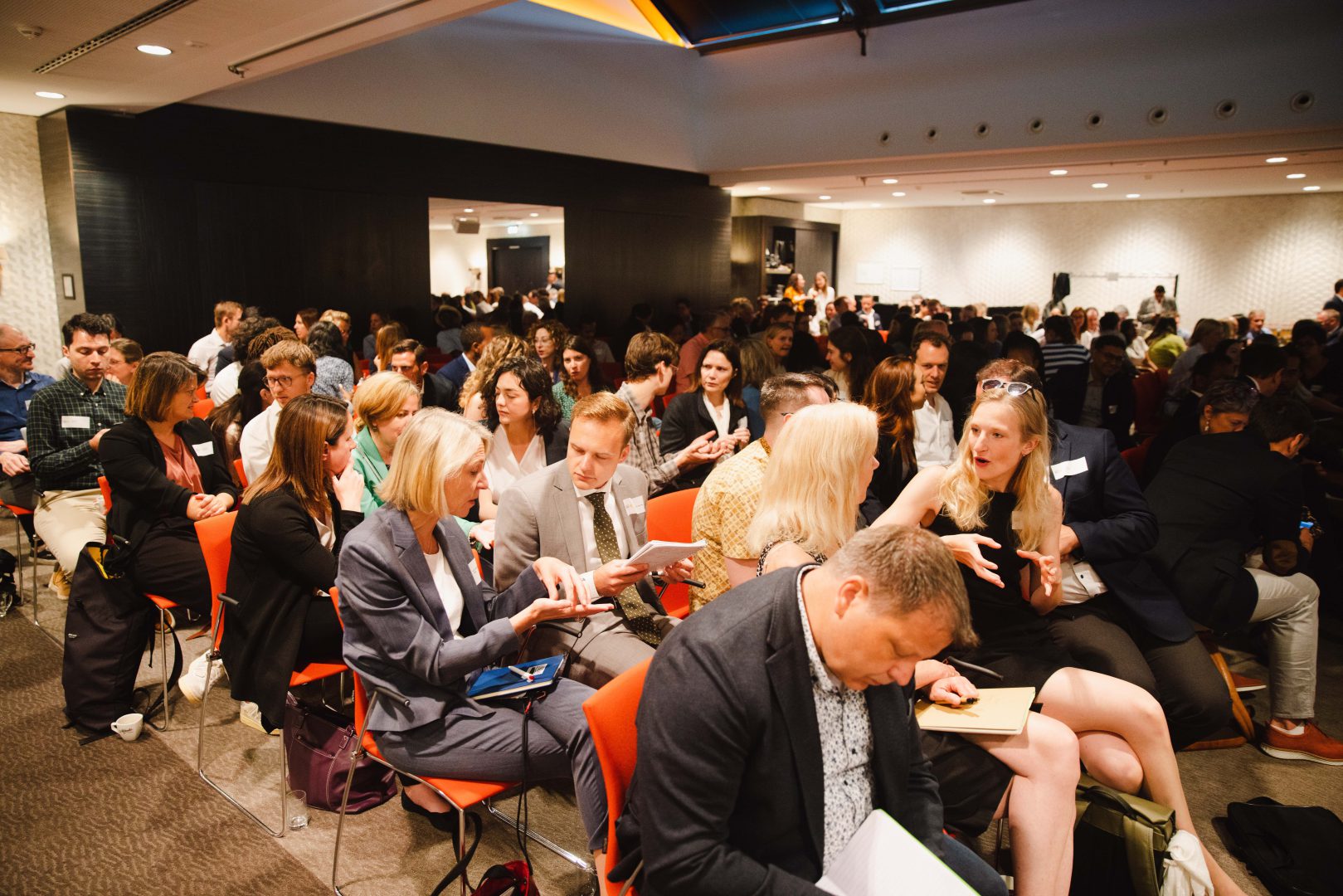
One month after the adoption of the EU Deforestation Regulation (EUDR), industry leaders, smallholder representatives, civil society experts and government representatives discussed the way forward. 300 participants gathered in Frankfurt (Main) on 14 June for the Sustainable Palm Oil Dialogue (SPOD) to exchange views on how the regulation can be implemented most effectively in the 18-month transition period.
The organisers expressed their support for the regulation and emphasised that traceability for sustainably produced palm oil is already relatively well advanced. Participants discussed the remaining challenges and solutions to reduce negative impacts on small-scale producers and small and medium-sized enterprises.
Together for sustainable palm oil
“Risk mitigation must be holistic – it must take into account and balance social and environmental aspects in value chains,” emphasised Sophia Gnych, Policy Analyst at the OECD, in her keynote. “Comprehensive and ongoing due diligence and risk mitigation are now part of the cost of doing business.”
To meet their due diligence obligations under the EUDR and further planned legislative initiatives, companies need transparent supply chains.
Although there is a growing number of traceability solutions, they are as yet barely interoperable. During the conference, participants had the opportunity to discuss data standards, sharing and interoperability. The Initiative for Sustainable Agricultural Supply Chains (INA) presented the Digital Integration of Agricultural Supply Chains Alliance (DIASCA) as a multi-stakeholder approach to interoperability between different IT solutions. The RSPO presented its plans for a new digital traceability platform that will also enable members to report on the conventional share of their palm oil.
In the oleochemical sector, traceability is even more complex. Participants had the opportunity to understand the unique dynamics of the oleochemical supply chain, from market scarcity to the particular challenges of tracing derivatives.
Even though the EUDR is an opportunity to improve transparency in this sector, it is important that smallholders’ access to the EU market is maintained. “If we include smallholders, we can change many things on the ground,” said Rukaiyah Rafik, Head of the FORTASBI Secretariat. Companies that exclude small-scale producers in order to reduce risk in their supply chain would not be contributing to solving the problem of deforestation. To ensure the inclusion of smallholders and to address other social and environmental issues together with all relevant stakeholders, landscape and jurisdictional approaches will play an important role.
Positive change requires both voluntary measures such as pre-competitive dialogue, certification and financial investment, and mandatory measures such as the EUDR.
Innovation Fair
SPOD 2023 also hosted this year’s Innovation Fair, organised by Sustainable Palm Oil Choice (SPOC) and Wageningen University & Research. Eight innovators presented their concepts to the participants, who voted for the most promising.
The winner of the Innovation Fair was Palmas del Ixcan from northern Guatemala: an agro-industrial company dedicated to the sustainable cultivation of palm oil in close cooperation with smallholders.
SPOD 2023 was jointly organised by Roundtable on Sustainable Palm Oil (RSPO), IDH, Forum for Sustainable Palm Oil (FONAP) and Initiative for Sustainable Agricultural Supply Chains (INA).
BACKGROUND
The EU regulation on deforestation-free products is intended to ensure that certain agricultural commodities consumed in the EU have not led to deforestation or forest degradation and were produced in accordance with the relevant legislation of the country of production. To this end, companies must fulfil due diligence obligations for palm oil and six other commodities as well as certain derived products.
Cover image: © NÓI CREW